2026/4/13 15:22:03
Data Centers and Cables: Building Reliable Digital Infrastructure with the Right Cable Solutions
BURYCABLE Website SEO Article | Full Word Version
Prepared for website publication. Content preserved in full for direct handoff to the web development team.
Data centers are now among the most critical infrastructure assets in the modern economy. Cloud computing, artificial intelligence, financial transactions, telecom networks, industrial automation, enterprise systems, and online services all depend on stable and secure data center operations.
When designing or expanding a data center, attention is usually given to servers, cooling, backup power, and network architecture. Yet one of the most fundamental parts of the system is often underestimated: the cable infrastructure.
Cables are what allow power to be delivered, data to move, control systems to function, and safety systems to remain operational when conditions become critical. In a data center environment, cable performance directly affects reliability, safety, scalability, and long-term operational efficiency.
For this reason, cable selection in data center projects should never be treated as a routine procurement item. It is an engineering decision with long-term consequences.
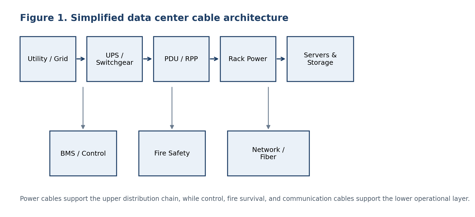
Figure 1. Simplified data center cable architecture showing how power, control, fire safety, and communication cables support different layers of a modern facility.
A modern data center is designed around continuity. Even a short interruption can lead to service instability, data loss risk, financial impact, and operational disruption. Because of this, every component in the electrical and communication chain must be selected with high reliability in mind.
Cable systems are essential because they support:
· power transmission to critical equipment
· network and communication connectivity
· monitoring and automation systems
· emergency and fire safety functions
· long-term maintainability and future expansion
In practical terms, poor cable selection can create problems such as overheating, signal interference, reduced fire safety, difficult installation, premature failure, and costly maintenance issues later in the project lifecycle.
By contrast, well-engineered cable systems support stable uptime, safer facilities, and more efficient infrastructure management.
Cable family | Main role | Typical data center areas | Key priorities |
LV / MV Power Cables | Primary and secondary power distribution | Substations, UPS rooms, switchgear, PDUs, equipment power feeds | Current capacity, thermal stability, reliability |
LSZH Power / Control Cables | Safer indoor installation where smoke performance matters | Server halls, cable routes, control rooms, indoor risers | Low smoke, low corrosive emissions, maintainability |
Fire Resistant Cables | Maintain circuit integrity during fire exposure | Fire alarm, smoke extraction, emergency lighting, critical shutdown systems | Circuit survival, compliance, life-safety resilience |
Shielded Control Cables | Support automation, BMS, monitoring, and equipment control | Cooling systems, generators, metering, access systems | Signal stability, EMC, installation consistency |
Copper / Fiber Communication Cables | High-speed data and network interconnection | Backbone links, rack rows, structured cabling, security networks | Bandwidth, shielding, attenuation, scalability |
Armoured Cables | Extra mechanical protection in harsher routes | Outdoor sections, underground entries, exposed industrial zones | Mechanical robustness, route protection, long-term durability |
Table 1. Typical cable categories and where they fit within data center infrastructure.
Data centers are complex environments that use multiple cable categories at the same time. Each serves a different function and must be matched to both performance requirements and installation conditions.
Power cables are the foundation of electrical distribution in any data center. They connect substations, transformers, switchgear, UPS systems, generators, PDUs, cooling systems, and rack power infrastructure.
Depending on project design, this may include:
· medium voltage power cables
· low voltage power cables
· armoured or unarmoured distribution cables
· LSZH indoor power cables
· backup and emergency supply cables
These cables must deliver stable electrical performance under continuous load and often under demanding thermal conditions.
Key priorities include:
· current carrying capacity
· insulation integrity
· overload resilience
· flame performance
· mechanical durability
· compliance with project standards
If power cables form the backbone of energy delivery, communication cables form the nervous system of the data center.
These cables are used for:
· server and rack connectivity
· structured cabling systems
· building management systems
· security and access control
· monitoring and automation
· control signaling between equipment
Depending on the application, this category may include copper data cables, fiber optic cables, bus cables, and shielded control cables.
In dense technical environments, communication cable performance is closely linked to:
· transmission stability
· electromagnetic compatibility
· shielding effectiveness
· low attenuation
· long-term signal integrity
As data centers become faster and more integrated, communication cable quality becomes even more important.
Fire protection is a major engineering priority in data center environments. Even where the risk of open flame is low, the consequences of fire can be severe due to high equipment density, enclosed spaces, and the importance of service continuity.
For this reason, many projects specify fire performance cables for critical systems such as:
· fire alarm circuits
· emergency lighting
· smoke extraction systems
· emergency shutdown systems
· critical control networks
· essential monitoring systems
It is important to distinguish between two common categories:
Flame retardant cables are designed to reduce the spread of fire.
Fire resistant cables are designed to maintain circuit integrity for a specified time under fire conditions.
Both may be necessary in a data center depending on the circuit function and the overall fire strategy.
Data centers rely heavily on automated systems. Cooling systems, generators, switchgear, access systems, energy management systems, and environmental monitoring all depend on control and instrumentation cabling.
These cables help operators manage:
· temperature and cooling control
· generator synchronization and backup systems
· electrical monitoring and metering
· fire and safety controls
· building automation
· remote alarms and equipment communication
As data centers become smarter and more automated, reliable control cable infrastructure is becoming increasingly important.
In indoor technical environments, fire risk is not only about flame. Smoke, corrosive gases, and toxic emissions can be equally dangerous. In a data center, these factors are especially serious because they can threaten both personnel safety and valuable equipment.
This is why Low Smoke Zero Halogen (LSZH) cables are widely specified for indoor data center applications.
LSZH cables help reduce:
· dense smoke generation
· corrosive gas release
· secondary damage to electronic systems
· visibility loss in emergency conditions
They are particularly suitable for enclosed spaces such as:
· server rooms
· UPS rooms
· cable routes
· control rooms
· technical corridors
· equipment halls
For high-value infrastructure, this is not only a safety issue but also an asset protection issue.
Property | Standard Indoor Cable | LSZH Cable | Why it matters in data centers |
Smoke emission | Can be higher depending on compound | Typically reduced | Improves visibility and emergency response in enclosed technical spaces |
Halogen gas release | May release corrosive gases when burned | Zero halogen formulation | Helps limit damage to servers, controls, and electronic equipment |
Suitability for occupied indoor areas | Depends on project specification | Commonly preferred | Supports safer installation in server halls and technical corridors |
Lifecycle risk profile | Varies by design and environment | Often better aligned with critical indoor use | Supports resilience where downtime and secondary damage are costly |
Table 2. LSZH cables are often preferred in indoor data center spaces because their fire by-products are less harmful to people and equipment.